33 Fun Group Activities for Adults (Indoor, Outdoor & Party Ideas)


Finding group activities for adults that genuinely work — not the awkward or overly complicated kind — can feel harder than it should be. You’re juggling different personalities, comfort levels and energy styles, and you want something engaging enough to bring people together, but relaxed enough that no one feels put on the spot.
At its core, a group activity for adults is any shared experience designed to spark interaction, conversation or collaboration among three or more people. That could mean a creative class, a competitive game night, an outdoor adventure or even a food-centered gathering. The key is that it gives everyone a role and lowers the pressure of small talk. Research published in Frontiers in Psychology highlights how shared experiences help adults feel more connected and engaged, which is exactly what the best group activities are built on.
Whether you’re planning a birthday, team outing, casual weekend hangout or large group event, this list covers indoor, outdoor, creative and food-focused ideas that scale easily for different personalities and group sizes. Some are low-key, some are high-energy, all of them are designed to help adults actually enjoy being together — brunch party ideas, party games or just things to do when you’re bored.
Jump to Section
- What Makes a Group Activity Actually Work?
- Indoor Group Activities for Adults
- Outdoor Group Activities for Adults
- Large Group Activities for Adults (10+ People)
- Creative Group Activities for Adults
- Food-Focused & Social Group Activities for Adults
- FAQs About Group Activities for Adults
- Final Thoughts
What Makes a Group Activity Actually Work?
/cooking_classes/Group_kneading_dough.png)
Not all group activities land the same way. The difference usually comes down to structure, comfort and energy.
The best group activities for adults tend to share a few traits:
- They reduce spotlight pressure. Not everyone wants to feel like they’re performing. Activities that allow participation without forcing it, like trivia teams or cooking challenges, tend to feel safer and more inclusive.
- They match the group’s energy level. A trampoline park might be perfect for an outgoing birthday crew, but a disaster for a mixed-age reunion. The most successful activities consider comfort levels, physical ability and personality mix.
- They create natural conversation. Shared tasks, like painting, solving clues, building something or tasting food, give people something to talk about beyond “So, what do you do?”
- They’re simple to understand. If you need a 10-minute rules explanation, you’ve already lost half the room. Clear, short instructions keep momentum high.
When you focus on those four elements, the activity itself almost becomes secondary. What matters most is that people leave saying, “That was actually fun,” instead of, “Well… we tried.”
Indoor Group Activities for Adults
Indoor group activities for adults are often the easiest to organize. They remove weather from the equation, work year-round and feel more manageable for mixed personalities. Whether you're planning a team outing, a birthday or a casual gathering, indoor options tend to create structure without forcing high energy.
1. Trivia Night (A Classic Crowd-Pleaser)

Trivia nights remain one of the most reliable group activities for adults because they balance competition with collaboration. When people play in teams, there’s no spotlight pressure, just shared guessing, debating and celebrating the occasional unexpected correct answer.
You can host trivia at home with themed rounds tailored to your group, or head to a local bar or brewery that runs weekly events. In team-building settings, mixing departments or friend circles into new teams helps spark conversations that wouldn’t otherwise occur. The format is familiar, which lowers hesitation, and the teamwork keeps even quieter participants involved.
Remember that the perfect trivia team consists of people with a variety of knowledge, so assemble your team accordingly.
2. Murder Mystery Games (Structured Social Fun)

Murder mystery games are ideal when you want something interactive without feeling chaotic. Each participant plays a character, which actually makes socializing easier because people have a built-in reason to talk to one another.
This is one of those indoor group activities for adults that works particularly well for larger groups because the structure guides the night. You can book a hosted experience, buy a downloadable kit or even organize a virtual version if guests are remote. It’s immersive without being intimidating, and the shared goal keeps energy steady throughout the event.
3. Board Game Night (Low-Pressure & Flexible)

Board games are often underestimated, but they remain one of the simplest group activities for adults that genuinely work. They create instant structure, are easy to scale and let people engage at their own comfort level.
For larger groups, set up multiple tables with different games running at once. That way, guests can rotate rather than waiting for a single round to end. Classics like Codenames, UNO or Ticket to Ride encourage teamwork, while lighter party games like Cards Against Humanity keep things moving. It’s budget-friendly, adaptable and surprisingly effective at keeping people off their phones. Monopoly might be a bust due to how long it takes to finish.
4. Karaoke Night (Energy Without Formality)

Karaoke works because it gives people a choice: perform or cheer. Not everyone wants the microphone, but most people enjoy being part of the audience.
For team-building settings, karaoke can break hierarchy quickly — there’s something humanizing about watching a manager sing a throwback hit. Hosting at home with a rented machine keeps it casual, while private karaoke rooms remove the pressure of singing in front of strangers. It’s lively without requiring athleticism or complicated rules.
5. Cooking Competition Party (Collaborative & Rewarding)

A cooking competition turns dinner into an activity rather than just a meal. How does it work? Split into teams, assign a theme or mystery ingredient and set a reasonable time limit. At the end, everyone eats the results.
Food-based group activities for adults work especially well because they create natural roles for each of the participants, like chopping, seasoning or plating, without forcing anyone to take center stage. If hosting feels overwhelming, booking structured cooking classes in your city can simplify logistics while still giving everyone hands-on involvement (and they learn to cook along the way). It blends creativity, cooperation and a shared reward at the end.
Team leads in various cities can invite participants to make pasta with cooking classes in Atlanta, roll sushi in Chicago or make awesome barbecue in Dallas. If you're exploring group activities for friends, you can also invite them over to enjoy online cooking classes — if you’d rather hang out at home.
6. Craft Night or Art Workshop (Creative & Relaxed)

Creative indoor group activities, like arts and crafts for adults, allow conversation to flow naturally because hands are busy. Painting, candle-making, pottery or photography workshops all create a shared focus point.
If your group includes mixed skill levels, structured art classes or guided workshops help remove the “I’m not artistic” hesitation. The experience feels purposeful rather than random, and everyone leaves with something tangible. It’s especially effective for groups that prefer connection over competition. Set a party theme or just let everyone quietly craft on their own with some vibing music pumping in the background.
Outdoor Group Activities for Adults
Fresh air changes group dynamics instantly. People move differently, talk more freely and tend to relax faster when they’re not confined to four walls. Outdoor group activities for adults work particularly well for larger gatherings because there’s space to spread out, form smaller clusters and shift energy naturally.
That said, the key is choosing something inclusive. Not every outdoor activity needs to be intense — some of the best options simply create room for connection.
7. Hiking (Conversation in Motion)

A well-chosen hike is one of the most underrated group activities for adults. The rhythm of walking side by side reduces the intensity of face-to-face conversation, making discussions feel easier and more organic.
Keep the trail accessible unless your group specifically wants a challenge. Moderate terrain, clear meeting points and a planned rest stop prevent frustration. In team-building settings, rotating walking partners halfway through helps naturally mix conversations without forcing formal introductions. It’s simple, low-cost and consistently effective. Ask team members to bring a packed lunch to enjoy at a scenic viewpoint or have a catering company prepare some goodies to reward your team.
8. Beach Volleyball (Low-Stakes Competition)

You don’t need Olympic-level skill for this one (but it is a great addition to Office Olympics). Beach volleyball works because it invites movement without demanding perfection. Most adults remember playing at some point, which lowers hesitation.
What makes it effective as a group activity for adults is the balance between action and downtime. While one team plays, others cheer, chat or rotate in. That ebb and flow keeps energy high without exhausting everyone. It’s particularly strong for mixed social groups where some prefer playing and others prefer spectating. You can also give the spectators tasks like handing out refreshments or coming up with team cheers.
9. Casual Soccer or Kickball (Team Energy Without Pressure)
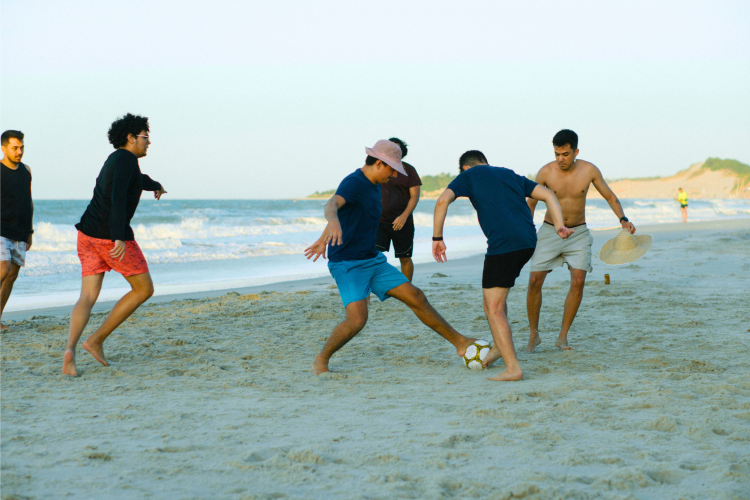
There’s something nostalgic about low-stakes field games. Set up basic boundaries, divide evenly and keep rules simple. No referees, no intense strategy — just movement and lighthearted competition.
Outdoor group activities for adults like this shine when expectations are clear from the start. Emphasize fun over scorekeeping. When the tone stays relaxed, participation increases across age groups and fitness levels. For corporate teams, these games can quickly break down silos in a way that feels playful rather than performative.
10. Rafting or River Tubing (Shared Adventure)

If your group has access to water, rafting or tubing creates built-in bonding. Navigating a current together — even a calm one — naturally encourages teamwork and communication.
This works best for groups that already know each other moderately well, as shared adventure amplifies group energy. Keep safety front and center, choose routes appropriate for mixed ability levels, bring lots of sunscreen (as people will forget), hydrate often and plan a casual meal afterward so the experience extends beyond the water.
11. Amusement Park Day (High-Energy Bonding)

Few activities level hierarchy faster than roller coasters. An amusement park trip is one of those outdoor group activities for adults that pulls everyone out of routine and into shared excitement.
To keep things smooth, designate meet-up times and smaller ride groups rather than trying to move as one large unit all day. That flexibility allows introverts to pace themselves while thrill-seekers chase adrenaline. For large teams, ending the day with a group dinner keeps the connection going beyond the rides.
12. Grown-Up Capture the Flag (Strategic & Playful)
Yes, adults can still play this! Actually, it’s surprisingly effective. It's kind of hilarious to see how quickly the stone-faced department head becomes a kid again in the heat of the moment. Capture the flag adds strategy to outdoor fun, which appeals to both competitive and analytical personalities.
Large parks work best. Assign clear boundaries and team identifiers, then let the planning begin. Because roles naturally form, such as defenders, scouts and distractors, people find their place without being assigned one. For teams that want something active but structured, this lands well.
13. Outdoor Movie Night (Low-Key & Scalable)

Not every outdoor group activity needs to be high energy. A projected movie in a backyard or park creates a relaxed, shared experience with minimal pressure.
Let the group vote on the film beforehand to build anticipation. Provide blankets, simple snacks and optional seating. It’s especially useful for mixed-age or mixed-energy groups where some want interaction and others prefer a quieter environment. The structure is clear, but engagement is flexible. For an added competitive twist, you can also hold a movie trivia pre-game. We have loads of trivia at-the-ready so that you don't have to plan frpm Christmas movie trivia to Halloween and Thanksgiving.
14. Community Volunteering Outdoors (Purpose-Driven Connection)

For groups that want something meaningful, outdoor volunteer activities add depth to the experience. Trail clean-ups, community garden projects or local park restoration efforts combine teamwork with visible impact.
Purpose-driven group activities for adults tend to create longer-lasting bonds because participants leave feeling accomplished. To keep morale high, choose manageable timeframes and end with a shared meal or coffee so the social element isn’t lost. Find out more heart-warming community service ideas for your group or the best charities to donate to.
Large Group Activities for Adults (10+ People)
Once your guest list climbs into double digits, logistics start to matter more than the activity itself. Large group activities for adults need built-in structure, flexible participation and room for smaller conversations to form naturally. Without that, energy stalls fast.
The following ideas work particularly well for 10 or more people because they scale without becoming chaotic — and they leave space for both outgoing personalities and quieter participants to find their footing.
15. Scavenger Hunt Around Town (Strategy Meets Movement)

Few large group activities for adults balance energy and teamwork quite like a scavenger hunt. Breaking into smaller teams instantly reduces intimidation while creating healthy competition.
Keep instructions simple: clear checkpoints, photo-based proof and a firm end location. Urban areas work beautifully, but even a park or neighborhood can provide enough material for creative clues. For team-building settings, mix groups intentionally so people collaborate outside their usual circles. The result feels adventurous rather than forced.
Build a trail of clues around your city and send teams racing to solve them, Amazing Race style. Use public transport, cars or keep it all on foot if you’re in a smaller town.
Before the hunt, pop into local stores and ask the owners if you can leave scavenger hunt clues at their stores. Teams will need to capture each solved riddle with their camera phones for evidence.
The first team to arrive at the final destination, with proof of each solved clue, wins a prize. It may be necessary to have a "Clue Master" that the teams can call for additional hints when they're stuck or to know if they're on the right track.
Team-building exercises work well for larger groups. Beyond scavenger hunts, we have a host of team building activities in your city, from escape rooms to simple ice breaker games that get people talking and working toward the same goal. You can find fun team building activities in Atlanta, Austin and NYC, along with dozens of smaller cities that run similar sessions.
16. Dance Class for Groups (Shared Learning, Shared Laughter)

Learning something new together is one of the fastest ways to build connection. A group dance class near you levels the playing field, whether you choose salsa, line dancing or even hip-hop basics. No one is an expert (or at least, most aren’t).
Professional-led sessions help large groups stay organized while maintaining high energy. Rotating partners halfway through encourages natural mingling without awkward icebreakers. It’s lively, memorable and surprisingly effective at dissolving stiffness in corporate environments.
17. Team Trivia Tournament (Structured & Scalable)

Unlike casual bar trivia, a tournament-style format keeps larger groups engaged. Assign team names, track scores publicly and build in themed rounds to keep momentum.
Because trivia naturally divides people into smaller pods, it prevents the “too many cooks” dynamic that can derail large gatherings. Adding a final lightning round keeps energy strong through the end. It’s competitive without being intimidating, which is a sweet spot for many adult groups. It's best to pick team members by drawing names from a hat to keep things fair.
18. Outdoor Field Day (Playful, Not Overly Serious)
Field days aren’t just for schoolyards. Simple relay races, tug-of-war or light obstacle courses create movement without requiring elite athleticism.
The trick here is to focus on tone (maybe one for HR to handle). Frame it as nostalgic fun rather than intense competition. Short rotations between activities keep things fresh and prevent fatigue. For larger teams, assigning lighthearted awards (Best Team Name, Most Dramatic Dive, etc.) adds humor without turning it overly serious.
19. Group Yoga or Wellness Session (Calm, Coordinated Energy)
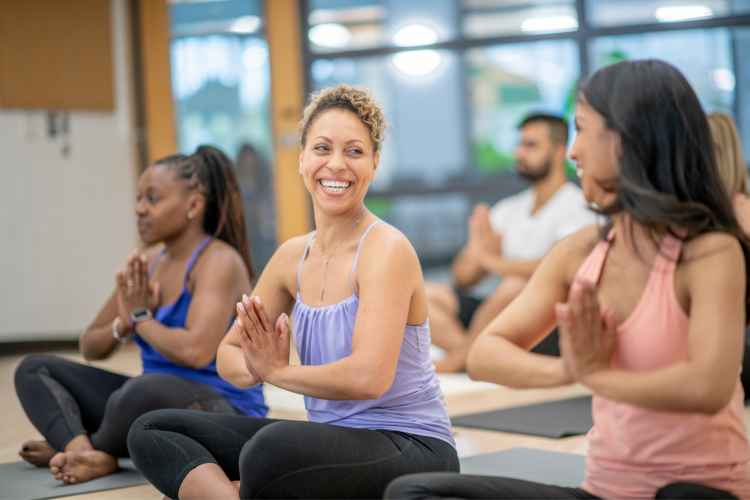
Not every large group activity for adults needs to be loud. A guided yoga, breathwork or outdoor meditation session creates shared stillness. This is something that many groups don’t often experience together. And it has a range of actual, well-documented health benefits for both mind and mood, according to a study published by Harvard.
Structured classes work particularly well because the instructor holds the room. Participants can engage at their comfort level, which makes it accessible across fitness levels. For workplace teams, this can reset energy in a way that’s both grounding and surprisingly bonding.
20. Aerial Parks

High ropes courses and aerial parks naturally generate cooperation. Participants often encourage one another from the ground, even if they choose not to climb themselves.
These activities succeed because they offer layered engagement. Some people tackle the course. Others cheer, document or help with gear. Everyone feels part of the experience without being required to perform. For large groups seeking mild adrenaline with structure, this is a strong option.
21. Cooking Challenge for Big Groups (Organized Collaboration)

We touched on smaller cooking competitions earlier, but scaling this for a large group changes the dynamic. Assign teams, provide shared ingredients and designate judges to maintain order.
If hosting independently feels overwhelming, booking structured cooking classes designed for large groups simplifies coordination. Professional instructors manage timing and equipment, which keeps the experience smooth. The payoff, which includes sitting down to eat what you created, always feels satisfying. Cooking classes in Boston, for example, have dumpling-making competitions. There are sushi showdowns with Austin cooking classes and pasta wars with Salt Lake City cooking classes.
22. Storytelling Circle With Guided Prompts (Connection Without Spotlight Pressure)

This works best with thoughtful facilitation. Rather than asking everyone to share publicly, break into smaller clusters and provide themed prompts: “A time I surprised myself,” or “The most unexpected lesson I learned.”
Large group activities for adults that prioritize listening over performing often create a deeper connection. Keeping prompts structured prevents rambling while maintaining a relaxed tone. When done well, this feels intimate rather than intimidating. Here are some random and deeper questions to ask, for additional guidance.
23. Arcade or Game Lounge Mixer (Choice-Based Engagement)

When a large group gathers in a space with multiple game options like pool tables, darts and retro arcade games, people self-organize naturally. The beauty of this format is autonomy. Participants drift between activities, conversations form organically, and no single focal point dominates the room. It’s social without being scripted, which can be ideal for mixed-age or cross-department teams.
Creative Group Activities for Adults
Creative group activities for adults tend to shift the energy in a room. Instead of competing or racing against time, people settle into making something. That shared focus, which makes hands busy and conversation flow, often creates a more natural connection than any icebreaker ever could.
These ideas work particularly well for mixed personalities because they give everyone something concrete to do.
24. Paint and Sip Night (Creative With a Social Edge)

Wine and a blank canvas might sound simple, but there’s a reason paint and sip keeps showing up on lists of reliable group activities for adults. It removes the pressure of being “good” at art. Everyone starts in the same place, and the point isn’t perfection — it’s participation.
You can book a guided paint and sip in your city, where an instructor walks everyone through the same piece step by step. That structure matters for larger groups because it keeps people moving at the same pace. If you’d rather host at home, ask each person to bring a bottle and follow an online tutorial together.
One tip: don’t overcomplicate the image. Landscapes, abstract color blending or simple silhouettes work far better than intricate portraits. The more achievable the design, the more relaxed the room feels. By the end, you’ll have a table full of wildly different interpretations, and usually a few unexpected hidden talents.
Paint and sip is so popular that you can do it anywhere, from paint and sip in Portland to Atlanta, Chicago to Jacksonville. Wherever you and your friends or colleagues are, you can team up for these relaxing group activities for adults. For friends, you can even set up a DIY paint and sip night at home by having each of them bring a bottle of wine to your house. For remote teams, some online painting classes work very well together.
25. Pottery Classes (Messy in the Best Way)

There’s something grounding about working with clay. Pottery slows people down in a way that’s surprisingly refreshing, especially for corporate teams who spend most of their time behind screens.
Booking pottery classes in your city ensures there’s enough equipment and guidance for everyone to actually enjoy the process. A good instructor will demonstrate technique, then circulate and help quietly, which keeps the atmosphere supportive rather than evaluative. Pottery classes are available in most major art cities that burst with creativity, like pottery classes in San Francisco, Austin and Minneapolis.
If you’ve never tried it as a group activity for adults, here’s what happens: people start quietly focused, then gradually begin chatting while shaping bowls or mugs. By the time everyone is comparing slightly lopsided creations, the mood has shifted entirely. It’s collaborative without being competitive, and no one leaves empty-handed.
26. Photography Walk (Creative Without a Classroom)

Not every creative group activity needs a studio. A photography walk works beautifully in cities, coastal towns or even quiet neighborhoods.
Choose a loose theme from reflections and doorways to bold colors or “things that make you laugh.” Give everyone 45 minutes to wander in small clusters and capture what fits. You can keep it casual, or turn it into a light challenge with categories and small prizes.
The magic happens afterward. Gather somewhere for coffee or drinks, then share your favorite shots projected onto a wall. People explain why they chose what they did, and suddenly you’re seeing the same street through completely different perspectives. It’s creative, low-cost and unexpectedly revealing.
27. Group Mural Project (Collaborative & Memorable)

If your group wants to create something lasting, a collaborative mural is one of the more meaningful group activities for adults.
Similar to the photography walk, it's best to start by choosing a shared theme like community, resilience, favorite travel memories or even an inside joke. Sketch a loose layout so each participant has a defined section. That structure prevents the design from turning chaotic while still allowing individual expression.
You don’t need a public wall. Large canvases or wooden panels work just as well and can hang in an office or home afterward. The process itself becomes the bonding moment: negotiating color choices, helping each other fill in details, stepping back together to assess progress. It feels purposeful rather than just decorative. It's a paint party idea for adults that combines fun, creativity and collaboration.
28. Flower Arranging Workshop (Calm & Surprisingly Engaging)

At first glance, flower arranging might sound quiet or even overly delicate. In practice, it’s one of the more accessible creative group activities for adults because it doesn’t require prior skill.
For your flower-arranging ideas, provide a mix of greenery, filler flowers, and focal blooms. Demonstrate a basic structure with a central height and support around the edges, then let people experiment. Some will go minimalist. Others will build something dramatic and overflowing.
The room usually shifts into relaxed conversation as hands trim stems and adjust angles. And unlike some activities, this one ends with something tangible that people are genuinely proud to take home and give as gifts. We have some exciting virtual flower-arranging classes that will help your team find space for the stems as they create the most beautiful bouquets. It's a calming, relaxed way to gain a new skill with your friends.
29. Creative Writing or Story Prompt Session (Low Gear, High Insight)

You don’t need paint or clay to spark creativity. A guided writing session can be just as powerful.
Provide short prompts: “The moment I almost changed careers,” or “A place I’d return to in a heartbeat.” Give everyone 10 quiet minutes to write. Afterward, break into small groups and invite volunteers to share.
This works well as a group activity for adults because it balances introspection with choice. No one is required to read aloud, but many do. Listening becomes just as meaningful as speaking. It’s particularly strong for teams that want connection without physical activity. For word-lovers, pair this with a book discussion where everyone can come with book club discussion questions to prompt more in-depth discussion.
Food-Focused & Social Group Activities for Adults
Food has a way of doing what structured icebreakers can’t. It slows people down, gives hands something to do and creates natural conversation. These group activities for adults lean into shared experience over competition, which are great for closing out a gathering on a high note.
30. Mixology Classes (Interactive & Lively)

For groups that want something a little more upbeat, mixology classes blend creativity with social energy. Shaking, tasting and comparing results creates instant interaction.
An experienced host can demonstrate foundational techniques like how to balance sweet, sour and bitter, before letting participants experiment. That structure keeps things organized even in larger groups.
For professional guidance assistance, hire an experienced mixologist for interesting lessons in mixology? An experienced mixologist will teach your team the handy skills they need to make the perfect craft cocktail with mixology classes in Las Vegas, Jacksonville, or San Diego.
If you’re hosting at home, assign each small team a base spirit and let them develop a signature cocktail. Have everyone sample and vote on favorites at the end. It’s playful without being chaotic, and it naturally sparks conversation. We have a variety of high-energy online mixology classes to choose from for at-home guidance.
31. Themed Potluck (Budget-Friendly & Personal)
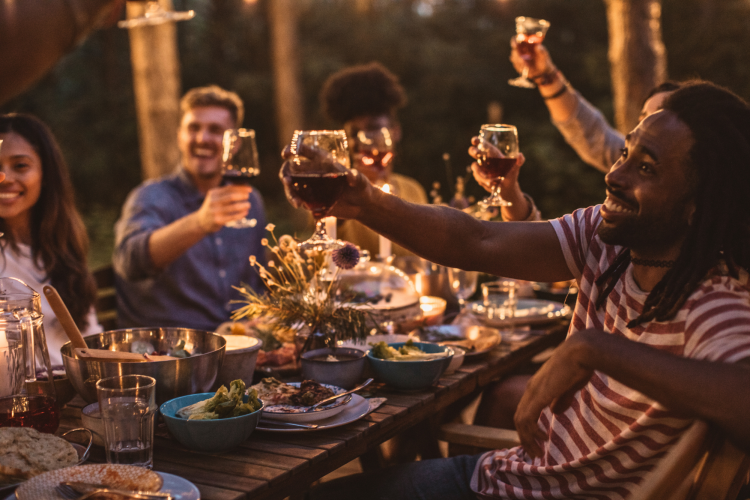
Sometimes, the simplest group activities for adults are the most meaningful. A themed potluck adds structure to what might otherwise be a casual meal.
Choose something specific for your potluck ideas — something that will inspire creativity: childhood favorites, international street food, or comfort dishes from your hometown. Ask each person to share a short story about why they chose their dish.
The storytelling element elevates this from “everyone brings food” to something more intentional. It’s affordable, inclusive and adaptable for large groups without complicated logistics.
32. DIY Food Tour (Explore Your Own City Differently)

You don’t need a formal guide to create a memorable experience. A DIY food tour turns an ordinary afternoon into something curated.
One small tip that makes a difference: assign each stop to a different person to research and introduce. That shared ownership keeps everyone invested and spreads responsibility without feeling like work.
Pick a theme and go from restaurant to restaurant with your pals. Great food tour themes include breakfast pastries, a specific type of drink like craft beer, or a specific regional food. For example, perhaps you set up a DIY Indian food tour and visit all of the Indian restaurants in town for different meals to taste the best Indian vegetarian food. You also get to support local businesses along the way, so it's a win-win.
Gather your foodie friends for a DIY food tour of your city. You may think you know every nook and cranny, but seeing it from a different perspective might open up never-before-seen avenues, literally.
33. Wine Tasting Night (Relaxed & Reflective)

Wine tasting works because it invites people to slow down and pay attention. You don’t need to be an expert. Choose a region, a grape variety or even a price point and compare. Some of our favorite girls' night ideas start off with a late afternoon wine tasting.
If you’re hosting at home, print simple tasting cards with prompts like “What does this remind you of?” or “Would you order this again?” Ask each friend to bring either a bottle of wine or something for a charcuterie board, and set up a virtual wine tasting. The structure gives conversation direction without turning it into a lecture.
Among group activities for adults, this one leans more reflective than high-energy — which makes it a strong option for winding down a long event or retreat.
FAQs About Group Activities for Adults

What Are Fun Group Activities For An Adult Party?
Fun group activities for an adult party usually combine structure with flexibility. Trivia nights, murder mystery games, mixology classes and themed potlucks work particularly well because they give guests something to focus on beyond small talk. The key is choosing an activity that allows participation without forcing anyone into the spotlight.
If your group prefers high energy, options like karaoke or a dance class can elevate the mood quickly. For more relaxed gatherings, cooking classes or wine tastings tend to create natural conversation without overwhelming quieter personalities.
What Are Engaging Group Activities For Adults?
Engaging group activities for adults typically involve collaboration, light competition or shared creativity. Activities like scavenger hunts, cooking challenges and team trivia tournaments keep people interacting without feeling pressured.
Engagement increases when:
- Instructions are simple
- Roles form naturally
- Everyone has something tangible to contribute
The most successful group activities for adults balance structure and autonomy. Too little guidance creates confusion. Too much structure feels forced.
What Are Good Indoor Group Activities For Adults?
Indoor group activities for adults work best when they’re easy to organize and adaptable to different comfort levels. Popular options include board game nights, guided art workshops, cooking classes, trivia events and murder mystery games.
Indoor settings remove weather variables and allow for clearer logistics, which makes them ideal for large groups or mixed-age gatherings. Structured classes can be especially helpful when you want a smooth experience without handling every detail yourself.
What Are Creative Group Activity Ideas For Adults?
Creative group activities for adults include paint and sip nights, pottery classes, photography walks, collaborative mural projects and even guided writing sessions. These activities shift the focus from competition to expression.
Creativity-based gatherings often feel more relaxed because hands are busy. That shared focus lowers social pressure and helps conversations unfold naturally. They’re particularly effective for teams or friend groups who prefer connection over high-energy competition.
How do you plan group activities for large groups of adults?
When planning group activities for adults with 10 or more people, structure becomes essential. Break participants into smaller teams, provide clear time limits and designate simple roles when needed.
A few practical tips:
- Choose activities that scale easily (scavenger hunts, field days, cooking workshops)
- Keep rules short and visible
- Build in natural breaks for conversation
- Avoid activities that require everyone to perform individually
Large groups thrive when the activity feels organized but not rigid. The goal is flow, not perfection.
How do you find group activities for adults near you?
To find group activities for adults near you, try searching with your city name included (for example, “indoor group activities for adults in Chicago”). Local recreation departments, community centers and event marketplaces often list workshops, classes and guided experiences.
If you’re planning something specific like cooking classes, pottery workshops or mixology sessions, many cities offer bookable options that handle instruction and materials for you, which can simplify coordination significantly.
Final Thoughts
The best group activities for adults aren’t about filling time. They’re about creating shared experiences that feel easy, natural and genuinely enjoyable.
Whether your group thrives on competition, creativity, movement or food, the right activity removes awkwardness and replaces it with momentum. Choose something that matches your group’s energy, give it just enough structure to run smoothly and let the connection do the rest.
And if you’d rather skip the planning altogether, booking guided classes — from cooking to art workshops — can simplify logistics while still delivering a memorable experience.
For even more fun activities, check out other experiences happening on Classpop!